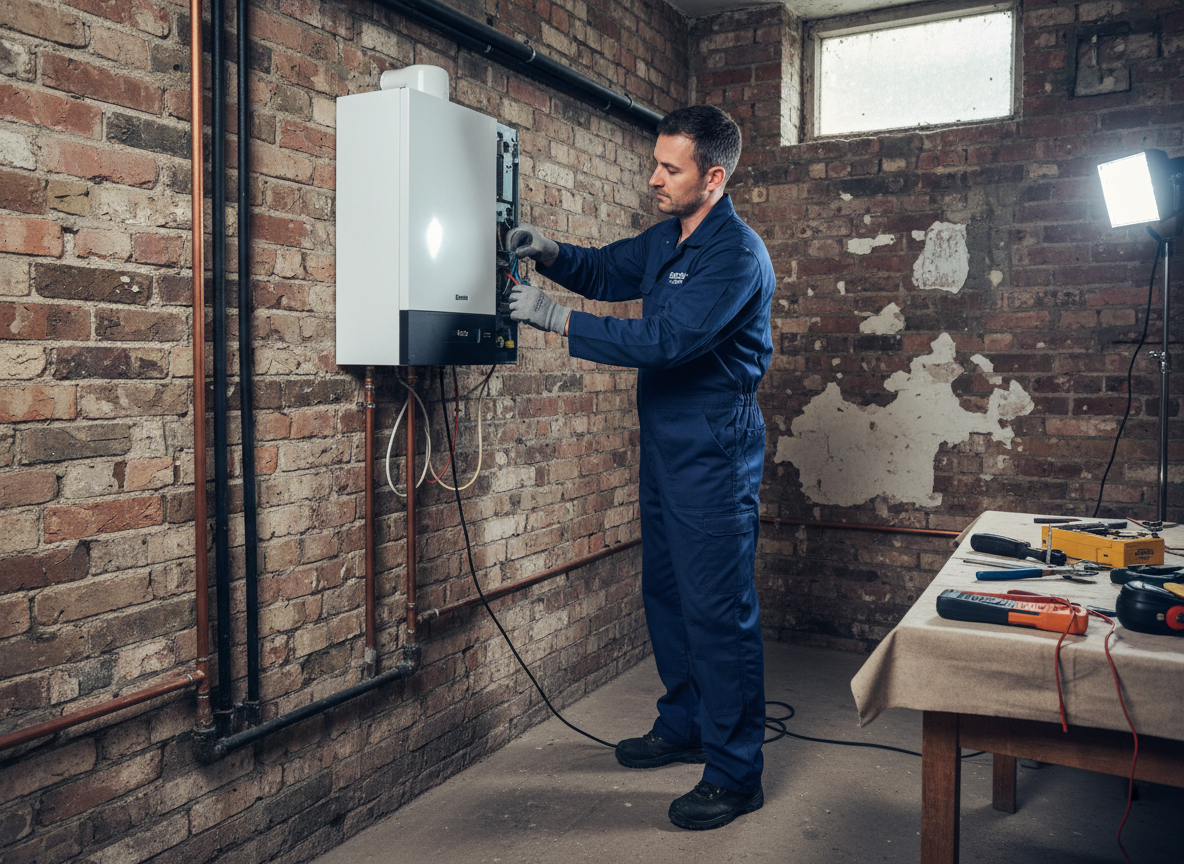
London's housing stock ranges from pre-1900 terraces in areas like Hackney and Islington to post-war estates and contemporary high-rises around Canary Wharf. Electric boiler installs in older properties often require checking and upgrading the consumer unit because many still rely on original wiring that cannot safely carry the load of a modern electric boiler. In newer flats the work centres on integrating with underfloor heating loops or replacing storage heaters while staying within the constraints of communal risers and limited plant room space.
Part P of the building regulations applies to every electric boiler job in Greater London. This means the installer must issue a minor works certificate and notify the local authority where necessary. Cold winters in the capital increase demand on the system, so we size units to handle rapid heat-up after overnight drops rather than running continuously. Soil conditions around the Thames do not directly affect indoor installs, yet damp basements in riverside properties like those in Rotherhithe require careful placement of the boiler to avoid corrosion of the casing and controls.
Edge cases include converting from night-storage heaters in 1960s council blocks where the existing economy-7 wiring must be isolated or removed. In listed buildings around Westminster or Southwark, visible pipework and controls must be kept minimal. We always verify the incoming supply with the district network operator before finalising the design because many streets in central London still operate on older 60-amp feeds that need upgrading before a 12 kW electric boiler can be commissioned.
Technician insight
In London, the thing that catches most people out with Electric Boiler Installer is the state of the consumer unit in pre-war terraces around Hackney or Islington. Many still have old rewireable fuses or early 1970s boards that cannot support the load, so the job turns into a full board upgrade before the boiler can even be connected.
Electric boiler swap in a Canary Wharf apartment
A top-floor flat near 1 Canada Square had an ageing electric boiler struggling to heat the open-plan living space. We found the original 6 mm² supply cable was undersized for the new 9 kW unit. We ran a new dedicated circuit from the consumer unit in the utility cupboard, fitted the boiler on the same wall, and recommissioned the underfloor loops. The system now reaches temperature within 25 minutes after the overnight drop typical on the Isle of Dogs.
How it works
- 1
Site Survey
We attend the property to inspect the existing electrical supply, consumer unit, and heating distribution. Measurements are taken for boiler location and any required cable runs.
- 2
Design and Quote
A detailed proposal is prepared showing the chosen electric boiler model, pipework changes, and any electrical upgrades needed to meet London building regulations.
- 3
Installation Day
The old heating source is isolated and removed. New boiler, controls and pipework are fitted, followed by full electrical testing and commissioning.
- 4
Handover and Certification
The system is demonstrated to the homeowner. A minor works certificate is issued and any required building control notification is completed.
Pricing
Upfront quotes provided after survey; final cost depends on property age, existing wiring condition and any required consumer unit upgrades.